
Pocket now lets you share links in-app
The widely used read it later app, Pocket, has received an update that makes it easier for you to share items with your friends who already use Pocket. You will now be able to send clippings and articles to users from within the app.
Pocket has always been more than just a read it later app. It always had the ability to share articles with family and friends via Facebook, Twitter and email. One feature that was sorely missed and much requested by Pocket regulars was the ability to share articles in-app.
The new update that bumps Pocket to 4.5.1 on Android and 4.5 on iOS now includes the ability to send an interesting article to people who use the app too. The person you send the article to will not just receive an email informing him about the share, but will also receive a push-notification within Pocket app that lets him know about it.
Pocket has always been more than just a read it later app. It always had the ability to share articles with family and friends via Facebook, Twitter and email. One feature that was sorely missed and much requested by Pocket regulars was the ability to share articles in-app.
The new update that bumps Pocket to 4.5.1 on Android and 4.5 on iOS now includes the ability to send an interesting article to people who use the app too. The person you send the article to will not just receive an email informing him about the share, but will also receive a push-notification within Pocket app that lets him know about it.
Neat little app gets a neat little update
The app now has a new share menu that will show you the services and friends you’ve most recently sent articles to. The Android version of the app has been updated to include auto full screen in article and web views too, apart from the regular bug fixes on both Android and iOS.
Pocket was formerly known as Read it Later, one of the first apps of this kind. The app, originally intended for computers only was started off in 2007 with the aim of being Tivo for web content.
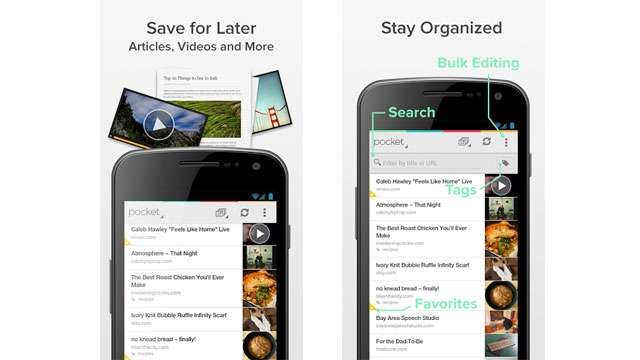
The app was rechristened to Pocket last year and doled out quite a few of its pro version options to the free version of the app. Currently, Pocket is available on not just iOS and Android devices, but also on Macs and as extensions on Google Chrome and Firefox. Using the app or the extension, you can save from nearly any page online including Twitter, Flipboard and Pulse. You can save articles, images and even videos to view them later on any of your devices. The best bit about Pocket is that it syncs the page you are on and the articles you’ve finished reading on every device you use.
The app boasts of more than eight million users across devices like iPhone and iPad, Android, Kindle Fire and browsers like Google Chrome and Firefox. The company also states that there have been more than 350 million items saved onto Pocket yet.
Pocket was formerly known as Read it Later, one of the first apps of this kind. The app, originally intended for computers only was started off in 2007 with the aim of being Tivo for web content.
The app was rechristened to Pocket last year and doled out quite a few of its pro version options to the free version of the app. Currently, Pocket is available on not just iOS and Android devices, but also on Macs and as extensions on Google Chrome and Firefox. Using the app or the extension, you can save from nearly any page online including Twitter, Flipboard and Pulse. You can save articles, images and even videos to view them later on any of your devices. The best bit about Pocket is that it syncs the page you are on and the articles you’ve finished reading on every device you use.
The app boasts of more than eight million users across devices like iPhone and iPad, Android, Kindle Fire and browsers like Google Chrome and Firefox. The company also states that there have been more than 350 million items saved onto Pocket yet.
Report by :
Nishtha Kanal


