Showing posts with label Google. Show all posts

Google Launches App Store for Docs and Sheets


Google is rolling out an online marketplace for third-party apps on Google Drive, the company announced Thursday.

The apps, which Google is calling add-ons, are available to Google Drive users in Docs and Sheets, the free online word-processing and spreadsheet services.

The add-ons are created by third-party developers and allow users to do things like sign documents, create customized email templates or make name tags from within documents and spreadsheets.

With the EasyBib bibliography add-on, for example, users can create bibliographies by searching the web for sources, choosing a style and inserting a formatted bibliography without ever leaving the document.

Users need to select the new "Add-ons" tab from within a doc or spreadsheet, then hit "get add-ons." From there, users can choose from the few dozen apps currently available in both app stores. Once an add-on is installed, it can be used from within any document in Google Drive.

Add-ons are only available within the latest version of Sheets, which Google launched in December — you'll need to upgrade before using them.

The feature is currently in developer preview phase, which means though anyone can create an add-on, developers must be approved by Google in order to publish them to the marketplace. Once the preview phase is over, any developer will be able to publish an app to the add-on stores for Docs and Spreadsheets.


Report by : Karissa Bell

Google redesigns search results page on desktop to bring it line with mobile UI


If you typed in a search term in Google today, you would have been greeted with a very odd-looking results page. The reason the page looks so drastically different is because of one simple change. Google has now removed underlines for URLs, making them more in line with the mobile search results page.

Google’s lead search designer Jon Wiley announced the makeover with a post on Google+. “This improves readability and creates an overall cleaner look. We’ve also brought over our new ad labels from mobile, making the multi-device experience more consistent,” he said about the redesign, while adding that it will now become possible for the company to roll out search changes across its mobile and desktop offerings more smoothly.

Besides reformatting the search results links, Google has made other little tweaks that may not be apparent at first glance, but do improve some of the nagging problems we had with the results page before. For example, like Wiley said, ads which used to sit at the top of the results in distinguishable blue and yellow boxes, no longer come in those marked areas. Instead, Google has decided to add an ad tag next to the link, to make the distinction clear.

While previously some monitors might not have reproduced the blue and yellow boxes very well, due to them being very light shades, now there’s no mistaking the ads, thanks to the well-displayed tag. You will also find that the search results’ font sizes have been increased.

Report by : Nikhil Subramaniam

Google Hangouts for iOS can call US & Canada for free, receive Google Voice calls


The Google Hangouts app for iOS is getting a major update this evening that gives it all new calling features on Apple's mobile hardware. Users can call phone numbers directly from the app itself, with no charge for any calls to US & Canadian numbers (international calls work too, for a fee). If they have a Google Voice account it's even more useful since it can both make and receive calls now, with outgoing calls showing your GV number and incoming calls popping up in the Hangouts app itself. Also new, are the better visible indicators of who is reachable right now that recently popped up in the Android version, inline animated GIF support and now incoming calls don't stop user's music -- they just pause it. We're already expecting Hangouts to take a step to the forefront in Android 4.4 KitKat -- check the app's placement in yesterday's Nexus 5 leak for a peek -- and this update will probably make things easier for users that cross back and forth between platforms.


Report by : Richard Lawler

Google to update its Terms of Service


The latest announcement from Google talks about the changes in its Terms of Service. The company will be modifying the terms, which will be officially put forth on November 11. The few changes that the company plans to make are related to privacy and security.

Firstly, Google wants to put the user in control of what they share. It will let users decide whether their profile names and images can appear in a review, advertising, etc on Google properties. This can be managed through the Shared Endorsements setting.

According to Google, “When it comes to shared endorsements in ads, you can control the use of your Profile name and photo via the Shared Endorsements setting. If you turn the setting to “off,” your Profile name and photo will not show up on that ad for your favorite bakery or any other ads. This setting only applies to use in ads, and doesn’t change whether your Profile name or photo may be used in other places such as Google Play.”

Google adds new Terms of Service

Secondly, the search giant wants to remind users to use its service safely. It advises against using Google's services during any activity that requires the user’s full attention, and clearly hints at driving.

Lastly, looks like the company wants users to be liable for their own stolen device, passwords and so on. It states, “Anyone you give your login details to could use them to access your Google Account and the stuff you store with Google. If we see something out of the ordinary (such as if we notice failed attempts to login to your account, or two logins to your account within a short time frame, but from computers located very far away from each other) you may see an unusual activity alert.” It will be asking users to add the two-step verification for further security.

Report by : Naina Khedekar

Google testing Google Shopping in India


Google has started displaying shopping results with search listings in India for select users.

What this essentially means is that when you search for a product, Google displays product listings from online retailers on the right side of the results page complete with product images, pricing and direct links under "Shop for 'Product name' on Google."

When we entered the search term 'Samsung Galaxy S4', Google displayed shopping listings from Flipkart, HomeShop18 and Yebhi. It's not just limited to mobile phones and tablets and we got shopping results for a wide range of products including apparel, LED TVs, air conditioners, refrigerators, among others. Online apparel store, Myntra is another partner as we also spotted results from the site.

On clicking the information icon accompanying the listing Google elaborates the reason why it displayed these products as: "Based on your search query, we think you are trying to find a product. Clicking in this box will show you results from providers who can fulfill your request. Google may be compensated by some of these providers."

Report by : Anupam Saxena

Google Translate adds five new languages including Marathi


Google has been pushing out language additions to Google Translate in a big way. It has added five new languages – including Marathi – to its repertoire of existing languages on Tuesday.

Google Translate has been an important part of most of our Internet existences, especially since we come in contact with foreign terms or phrases quite often. For travelers too, Google Translate is pretty indispensable during their trips abroad. Google has been updating its service with language packs regularly too.

Translate Marathi at ease now

This time round Google has added some more languages like Bosnian, the official language of Bosnia and Herzegovina, Cebuano, spoken in the Philippines, Hmong spoken in countries like China, Vietnam and Laos and Javanese, the second most-spoken language in Indonesia. Google has also added Marathi to its mix of already existing Indian language options like Bengali, Gujarati, Hindi, Kannada, Tamil, Telugu and Urdu.

Google believes that the addition of these languages will help users of the service as more than 183 million people around the globe speak these languages. It’s important to note that with the exception of Bosnian, the new languages are in “alpha” mode. This means that the quality of these languages is not quite perfect, but Google will be continuing to test and improve them over time.

Report by : Nishtha Kanal

US officials to Delhi court: Can’t summon Facebook, Google


US officials have told the Indian government that they cannot serve summons to Facebook and Google executives, as requested by a Delhi court, because that impacts “free speech principles".

India had asked the US to help in serving papers to the executives of 11 Internet companies who are accused of hosting content designed to fuel communal hatred.

In January this year, the court issued fresh summons for the executives and asked the Ministry of Home Affairs to ensure they were delivered. “As you know, there are limits to our Constitution’s protections on free speech, such as when the speech comprises a true threat or incites imminent violence. In this case, there has not been a sufficient showing in this regard,” US authorities said in response.

Facebook and Google won't have to appear in Indian courts just yet

The case was filed in December 2011 by a journalist named Vinay Ray who said Internet firms should be prosecuted for hosting the content. The case will be heard in Delhi on May 21.

Even as Google and Facebook get a breather from appearing in court over allegedly hosting offensive content, the search giant has had to deal with another legal issue pertaining to the Google Mapathon event’s India leg. While Google has maintained that the Mapathon contest was in line with Indian laws, the company could see some court time in India over allegedly violating the cartographical laws of the land.

Another petition filed with the Delhi High Court questions the legality of allowing minors to register on Facebook or the likes. The High Court is awaiting a response from the government, which was asked to explain why minors are allowed to enter contracts with social network.

Report by : Nikhil Subramaniam

Google Chairman says Project Glass won't ship before 2014


There has been a lot of buzz regarding Google's famed Project Glass. It was expected that the company will start offering these glasses to the consumers sometime this year. However, it now seems the users will now have to wait till 2014 to get their hands on this device.

Dvice website is reporting that this time frame has been provided by none other than Google's Executive Chairman Eric Schmidt while speaking to Martha Kearney on BBC Radio 4. Responding to the Kearney's query on, "How soon is [Google Glass] likely to come onto the market?" Schmidt said, "There will be thousands of [Google Glass] in use by developers over the next months, and then based on their feedback, we'll make some product changes, and it's probably a year-ish away."

Though that is quite a wait for Google Glass, but this product may come with a feature that enables you to click pictures by just winking. Engadget is reporting via Reddit user Fodawim that Google Glass's companion Android app has code for enabling and disabling eye gestures. This also means that it might an optional feature that can be used when required.

Google CEO Larry Page had recently confirmed in an earnings call that Google Glass indeed runs on Android. Google has already announced the specifications of the this device.

The Internet-connected glasses will feature a 5-megapixel camera, which is capable of recording 720p videos. The search engine giant has not disclosed the exact specifications of the display inside Glass, but did mention that the resolution will be equivalent to that of a '25-inch high definition screen from eight feet away'. Google Glass will also feature a Bone Conduction Transducer for audio.

Glass will be compatible with any Bluetooth-capable phone, however, for using GPS and SMS it requires the MyGlass companion app which is only available for smartphones running Android 4.0.3 (Ice Cream Sandwich) or higher. As per Google, Glass will offer 16GB internal storage space out of which 12GB will be usable and will be synced with Google cloud storage.

The company doesn't specify the battery capacity but mentions that it will offer one full day of typical use, however, it also warns that some features, like Hangouts and video recording, are more battery intensive. Glass will include a Micro-USB cable and charger.

Though there is now word on what will be the cost of Google Glass, but Larry Page did indicated that this thing would not come cheap.

Report by : Surbhi Chawla

Former Google CEO shares vision in tech treatise


Some illuminating books already have been written about Google's catalytic role in a technological upheaval that is redefining the way people work, play, learn, shop and communicate.

Until now, though, there hasn't been a book providing an unfiltered look from inside Google's brain trust.

Google Executive Chairman Eric Schmidt, who spent a decade as the company's CEO, shares his visions of digitally driven change and of a radically different future in "The New Digital Age," a book that goes on sale Tuesday.

It's a technology treatise that Schmidt wrote with another ruminator, Jared Cohen, a former State Department adviser who now runs Google Ideas, the Internet company's version of a think tank.

The book is an exercise in "brainstorming the future," as Schmidt put it in a recent post on Twitter - just one example of a cultural phenomenon that didn't exist a decade ago.

The ability for anyone with an Internet-connected device to broadcast revelatory information and video is one of the reasons why Schmidt and Cohen wrote the book. The two met in Baghdad in 2009 and were both struck by how Iraqis were finding resourceful ways to use Internet services to improve their lives, despite war-zone conditions.

They decided it was time to delve into how the Internet and mobile devices are empowering people, roiling autocratic governments and forcing long-established companies to make dramatic changes.

The three years they spent researching the book took them around the world, including North Korea in January over the objections of the U.S. State Department. They interviewed an eclectic group that included former Secretary of State Henry Kissinger, Mexican mogul Carlos Slim Helu, WikiLeaks founder Julian Assange and the former prime ministers of Mongolia and Pakistan. They also drew on the insights of a long list of Google employees, including co-founders Larry Page and Sergey Brin.

The resulting book is an exploration into the opportunities and challenges that lie ahead as the lines blur between the physical world around us and the virtual realm of the Internet. Schmidt and Cohen also examine the loss of personal privacy as prominent companies such as Google and lesser-known data warehouses such as Acxiom compile digital dossiers about our electronic interactions on computers, smartphones and at check-out stands.

"This will be the first generation of humans to have an indelible record," Schmidt and Cohen predict.

To minimize the chances of youthful indiscretions stamping children with "digital scarlet letters" that they carry for years, online privacy education will become just as important - if not more so - than sex education, according to Schmidt and Cohen. They argue parents should consider having a "privacy talk" with their kids well before they become curious about sex.

Not surprisingly, the book doesn't dwell on Google's own practices, including privacy lapses that have gotten the company in trouble with regulators around the world.

Among other things, Google has exposed the contact lists of its email users while trying to build a now-defunct social network called Buzz. It scooped up people's passwords and other sensitive information from unsecured Wi-Fi networks. Last year, Google was caught circumventing privacy controls on Safari Web browsers, resulting in a record $22.5 million fine by the U.S. Federal Trade Commission. European regulators have a broad investigation open.

Google apologized for those incidents without acknowledging wrongdoing. Schmidt and Cohen suggest that is an inevitable part of digital life.

"The possibility that one's personal content will be published and become known one day - either by mistake or through criminal interference - will always exist," they write.

The book doesn't offer any concrete solutions for protecting personal privacy, though the authors suspect that calls for tougher penalties and more stringent regulations will increase as more people realize how much of their lives are now in a state of "near-permanent storage."

"The option to `delete' data is largely an illusion," Schmidt and Cohen write.

People can choose not to put any of their information online, but those that eschew the Internet risk become irrelevant as online identities become increasingly important, the book asserts. Schmidt and Cohen foresee an option that will allow all of a person's online accounts - Facebook, Twitter, LinkedIn, Netflix and various other subscriptions - to be merged together into a "constellation" that will serve as a one-stop profile.

Eric Schmidt has written The New Digital Age along with Jared Cohen

If this book is right, there is no turning back from the revolution that is making Internet access as vital as oxygen and mobile devices as important as our lungs.

As much disruption as there already has been since Google's inception in 1998, Schmidt and Cohen contend that the most jarring changes are still to come as reductions in the cost of technology bring online another 5 billion people, mostly in less developed countries. At the same time, the combination of more powerful microprocessors, much-faster Internet connections and entrepreneurial ingenuity will turn the stuff of science fiction into reality.

Schmidt and Cohen are convinced that holograms will enable people to make virtual getaways to exotic beaches whenever they feel need. Nasal implants will alert us to the first signs of a cold. Virtual assistants - the kind Google is developing with Google Now and Apple with Siri - will become constant companions that influence when we shop and what we buy. Those assistants will generally steer us in directions drawn from an analyses of our personal preferences vacuumed off the Internet and stored in vast databases.

These aren't far-out concepts to the tech cognoscenti, or even younger generations who can barely remember what it was like to surf the Web on a dial-up modem, let alone use a typewriter.

The ideas will be more unnerving to older generations still trying to figure out all the things that their smartphone can do.

Schmidt, who will turn 58 on Saturday, can remember the days before there were personal computers. But he has been studying tech trends for decades, long before he became Google's CEO in 2001 and became a mentor and confidant to company co-founders Page and Brin. That collaboration established him as one of the world's best-known executives and minted him as a multibillionaire. Before joining Google, he was chief technology officer at Sun Microsystems and CEO of software maker Novell Inc.

Many of the book's themes expand upon topics that Schmidt regularly mused about in speeches and interviews that he gave as Google's CEO. Some of his past remarks, particularly about the loss of privacy, rankled critics who believe Google had become too aggressive in trying to learn more about people's individual interests so it could sell more ads, its chief source of revenue.

Schmidt also won plenty of admirers in powerful places, including President Barack Obama, who called upon Schmidt's advice during his 2008 campaign. Political pundits once considered Schmidt to be a leading candidate to join Obama's cabinet, though Schmidt has said he never had any interest in a government job.

Schmidt relinquished the CEO job to Page two years ago, freeing him to devote more time traveling to meet government leaders around the world.

Cohen, 31, is regarded as a rising star in tech circles, though he isn't as well-known as his co-author. Time magazine just named Cohen as one of the world's 100 most influential people in its annual list. Cohen worked on State Department policy planning and counter-terrorism in both the Bush and Obama administrations.

Schmidt and Cohen emerged from their research convinced that most governments don't fully understand the implications of ubiquitous Internet access and mobile computing. They expect repressive regimes to do everything in their power control the flow of information and to abuse databases to spy on citizens. They also foresee smaller countries waging computer-based attacks on countries they would never target with troops and weapons.

Even as they address the dark sides of technology, Schmidt and Cohen hypothesize that the world ultimately will be better off as more people spend more time connected to each other on the Internet. Societies will be more democratic, governments will become less corrupt as their transgressions are exposed and people will become smarter and better informed.

"Never before in history have so many people, from so many places, had so much power at their fingertips," Schmidt and Cohen assert.

Report by : Associated Press

Apple's iPhones do not violate Google patent, rules US trade commission


Apple scored a win yesterday when the US International Trade Commission ruled that it did not violate a Google patent to make the popular iPhones.

Apple had initially been accused of infringing on six patents for iPhone-related technology covering everything from reducing signal noise to programming the device's touch screen so a user's head does not accidentally activate it while talking on the phone.

If Apple had been found guilty of violating the patent, its devices could have been banned from being imported into the United States.

Google can appeal the decision to the U.S. Court of Appeals for the Federal Circuit. "We're disappointed with this outcome and are evaluating our options," the company said in a statement. A spokeswoman for Apple declined to comment.

Another courtroom victory!

The smartphone industry has seen dozens of lawsuits on several continents as Apple vies for market share with companies that make smartphones that use Google's Android software.

Google acquired the patents in the case along with the lawsuit when it purchased Motorola Mobility for $12.5 billion last year, partly for its library of telecommunications patents.

Google's Android software, which the company lets handset makers use for free, has become the world's No. 1 smartphone operating system, ahead of the iOS software used on Apple iPhones.

The ITC, a U.S. trade panel that investigates patent infringement involving imported goods, is a popular venue for patent lawsuits because it can bar the importation of infringing products and because it issues decisions relatively quickly.

Motorola Mobility, which has since been acquired by Google, accused Apple in 2010 of infringing on six of its patents. Two were terminated from the case, and the ITC said last August that Apple was innocent of infringing three others.

But the commission had also asked its internal judge, Thomas Pender, to reconsider its finding that Apple did not violate a fourth patent, which is for a sensor to monitor the location of a user's head to keep it from maneuvering on the touch screen. Pender found that patent obvious in December, and the full ITC came to the same conclusion on Monday.

The case in the ITC is In the Matter of Certain Wireless Communication Devices, Portable Music and Data Processing Devices, Computers and Components Thereof, 337-745.

Report by :

Google’s Street View goof sees biggest fine yet (but regulators wanted more)


Germany privacy regulators have fined Google €145,000 ($189,000) for its Street View cars inadvertently harvesting WiFi network data, in what was described as “one of the biggest data protection rules violations known.” The penalty is nearly the biggest amount permitted for negligent data rule contravention in Germany, and comfortably exceeds a €100,000 fine imposed in France two years ago. However, if regulators had their way [pdf link], Germany’s Data Protection and Freedom of Information commission says, Google would be fined far more.

The decision by German regulators to punish Google’s inadvertent data-gathering is the latest in a string of fines the search giant has been hit with. Between 2008 and 2010, the company admitted, its fleet of camera-toting Street View cars accidentally collected and stored wireless network information including emails, passwords, photos, and more.

Google maintains that it was an accidental goof, with global privacy counsel Peter Fleischer saying that the collection was not intended, that the data was unwanted, and that the Street View team did not look through it. However, privacy groups in Europe decided to re-open their investigations last year, after it was revealed that the engineer responsible for programming the systems knew what would be collected.

According to Hamburg data regulator Johannes Caspar, “internal control mechanisms must have severely failed” and made Google’s actions, in his view, one of the largest violations to-date. In fact, he argues that current limits on data protection failures should be considerably higher. “As long as violations of data protection laws are punishable by discount rates, the enforcement of data protection laws in a digital world with its high potential for abuse will be all but impossible” Caspar suggests.

New regulations could make the sting far greater in the future, however. One possibility being discussed by European policy makers is that the maximum should be based on a company’s total annual turnover, with calls for a 2-percent cap. Based on Google’s 2012 total revenues of more than $50bn, that could have meant a potential fine of one billion dollars, had the search giant been penalized under the proposed limits.

Report by : Chris Davies

Nexus 4 with LTE said to debut at Google IO 2013


In roughly one month, Google is expected showcase some new Android wares at the annual Google IO in San Francisco.

While most of the pre-show hype has been focused on Google Glass, a possible new Nexus 7 and the (fingers crossed) reveal of the Nexus 5, that's not all supposedly Google has in store.

A new report from SIDHTech indicates there also might be a new version of the extremely popular Nexus 4 at IO, complete with new networking capabilities and improved storage.

Not only that, but the site also said this updated Nexus 4 will feature Android 5.0, and could be arriving as early as this summer.

Who's got Nexus?

Let's break down the rumor, which is definitely just that.

According to the site, Google might be planning a 32GB Nexus 4 with LTE and CDMA support during the conference.

The CDMA part is particularly intriguing for U.S. carriers Sprint and Verizon, which require compatibility with the radio waves to a support phones on their LTE networks.

The rumored boost of 32GB of storage coming in this new and improved Nexus 4 should also go a long way in alleviating concerns of the original model.

The original Nexus 4 only arrived in November 2012, so the announcement of a Nexus 5 so soon after its release may seem a bit counter-intuitive.

Announcing a slightly revamped version of last year's model on carriers that call for LTE does make a bit more sense given the timing, but we can't really know for sure until Google decides to tell us the facts.

Report by : Luke Brown

Google CEO on Andy Rubin, Sundar Pichai and Android


It's been more than a month since Sundar Pichai took over as Android chief replacing Andy Rubin. The unexpected change raised questions about Android's direction especially with the company refusing to talk about Rubin's new role. A question related to the same was raised during the Q&A session of Google's recent earnings conference call.

Scott Devitt of Morgan Stanley asked Google CEO Larry Page to discuss the transition in Android management and Andy Rubin's new role.

Page reiterated that Rubin had established Android as the most used operating system in the world and that he had decided it was time to hand over the reigns and start a new chapter at Google. However, he dodged the question did not shed any light on Rubin's new role.

"I think, as we've already said, we've really exceeded crazy ambitious goals we dreamed of for Android. It's the most used mobile operating system in the world and a very big thanks to Andy for that. He really decided it was time to hand over the reigns and start a new chapter at Google. And we actually have an outside - we haven't said what that is and I'm not going to make news today on that," said Page.

Page said that Pichai would lead Android in addition to his existing work on Chrome and apps and that the transition was smooth.

"And actually going forward, Sundar is going to lead Android in addition to his existing work on Chrome and apps. He has a great talent for creating products that are really technically excellent yet easy to use and he loves a big bet too. So, we said how that performed I think we had very smooth transition and of course excited about the future," he added.

Andy Rubin had stepped down as the executive in charge of Google's Android operating system for smartphones and tablet computers in March, after seven years of leading the platform.

Google replaced Rubin with Sundar Pichai, an executive in charge of the company's Chrome Web browser and operating system for lightweight laptop computers, giving way to the recurring speculation that the Chrome operating system eventually will supplant Android. Google executives so far only have said they want to make sure the two operating systems can operate cohesively together.

Report by : Anupam Saxena

Gongkai phone sells for $12


Ever thought of paying as little as $12 (amounts to approximately Rs 650) for a fully-functional phone? Well, we came across the Gongkai phone, which now makes it possible. It's a complete quad-band GSM phone featuring an OLED display, Bluetooth and MP3 playback. It has only basic features, but that's what one could expect at that price. The phone is a great option if you are going on a short trip/vacation or during the monsoon when people don't want to carry their expensive smartphones. Moreover, at $12, the phone is unlocked and contract-free; it also comes with a protective silicone sleeve.

A basic phone for $12 (Image credit: bunnie studios)

After a teardown, bunnie studios reveals that the low price of the phone is possible due to several factors. The entire case snaps together and there are no screws holding the phone together. There are almost no connections inside and all components, such as the battery and display, are soldered directly to the board. There is a flipping switch that helps hard-disconnect the battery. Further, the battery also has no secondary protection circuit. Despite its slacky built, the phone features a backlit keypad and decorative lights around the edge. It equips the Mediatek MT6250DA chip and a Vanchip VC5276. The CPU clocks at 260MHz, 32-bit. The MT6250 chip is said to sell for less than $2 when bought in bulk. Apparently, the production price of the phone goes below $10.

Last year, we came across the M2 phone from a Chinese handset manufacturer going by the name Ken Xin Da. The phone priced at Rs 1,200 was amongst the tiniest phones one could find in the market. It came with a dual-SIM, dual-standby option, rated talktime of 240 minutes and bundled a 2GB memory card.

Affordable tablets and phones are a boon for developing nations like India. In fact, we’ve had our tryst with the Aakash tablet project. We’ve seen this cheapest tablet in the world face a lot of ups and downs. One shouldn't expect superior quality or performance from Gongkai either (considering its price). The price of the device is as low as ordering a highly-loaded large pizza or a nifty pair of earphones. A sub-Rs 1,000 phone could be a great initiative for India, especially as we are looking to connect remote and isolated regions of the country.

Report by : tech2 News Staff

Security firm finds 32 apps on Google Play infected with malware


While Google Play has caught up with Apple's App Store in terms of sheer number and quality of apps, the service's open nature still causes trouble now and then. Security firm Lookout is now warning users against 32 apps on Google Play that have been found to be infected by a malware called BadNews. If installed, the malware sends messages to premium rate text numbers.

The malware won't be detected immediately after installing the apps. It has been designed to stay dormant for a few weeks so as to avoid detection. To be specific, the malware has been specifically targeted towards Android users in Eastern-European countries such as Russia, Ukraine and Belarus. The premium rate message-sending malware is quite popular in Eastern Europe and Russia.

Google has removed the apps since Lookout's warnings, but the security firm estimates that the malware has been downloaded between 2 to 9 million times. Some of the infected apps included wallpaper apps, recipe generators, games and porn apps.

More malware hits Google Play and is promptly removed

Because of its overall open nature, Android is well known for some of the flaws in its security. According to a report back in February, ninety-nine percent of newly discovered mobile malicious programs target the Android platform, while only a very small amount targets Java and Symbian-based smartphones. The report found that 2012 was the second year to show explosive growth in Android malware.

The majority of Android malware can be divided into three main groups according to functionality. Elaborating further, the report adds that “SMS Trojans” empty victims’ mobile accounts by sending SMS texts to premium-rate numbers. Backdoors provide unauthorised access to a smartphone, making it possible to install other malicious programs or steal personal data. Spyware targets the unauthorised collection of private data, such as address books and passwords (or even personal photos in some cases).

In the first half of 2012, Backdoors, SMS Trojans and Spyware combined accounted for 51 percent of all newly discovered Android malware. In the Top 10 chart of Android malware that was blocked by Kaspersky Mobile Security or Kaspersky Tablet Security, SMS Trojans emerged to be the most widespread, with applications showing unwanted ads to users in second place.

Less widespread but by far the most dangerous are mobile banking Trojans that often work in conjunction with their desktop counterparts, as was the case with Carberp-in-the-Mobile.

The Android platform allows software installation from untrusted sources, and one of the best ways to guarantee an infection is to install programs from suspicious websites. However, malware on the official Google Play application distribution platform is another trend that started in 2011 and continued in 2012, despite Google’s best efforts to reduce cybercriminal activity.

One of the most unusual examples of mobile malware in 2012 was the "Find and Call" application that managed to sneak into the Google Play store as well as Apple’s app store.

Report by : Shunal Doke

Google’s Larry Page hints at upcoming rugged Motorola devices


Google announced their latest quarterly earnings yesterday, and the company had another good three months in the black, earning a revenue of $14 billion, with $3.35 billion of that as cold, hard income. However, Google’s recently-acquired Motorola Mobility is struggling, losing $271 million, but Google CEO Larry Page seems to have big plans for the subsidiary, and teased some of the features we may see on upcoming devices.

During Google’s earnings call yesterday, Page discussed Motorola and mentioned that he has seen some of the company’s upcoming products, saying that he’s “really excited to see the potential there.” He discussed the problems with current hardware, such as short battery life, shattered screens, and phones breaking when users accidentally drop them.

Page notes that these things simply just shouldn’t happen, which means that Motorola’s upcoming devices could come with improvements to these three categories. We’ve heard a lot of rumors about a possible “X Phone,” which is said to currently be in the works over at Motorola, and it’s possible that the phone will come with a type of ruggedness unlike what we’ve seen before.

This means that the X Phone could be classified as a rugged smartphone, but it won’t be bulky and thick like most rugged phones are. Instead, it could come with a toughened exterior along with an unbreakable type of glass for the display, as well as large battery similar to what’s in the DROID RAZR MAXX HD. As far as when we might see a phone like this come to the public, it could be later this year in time for the holiday season, but we’re not counting on that 100% just yet.

Report by : Craig Lloyd

Google's One Today app will let you donate $1 daily for a good cause


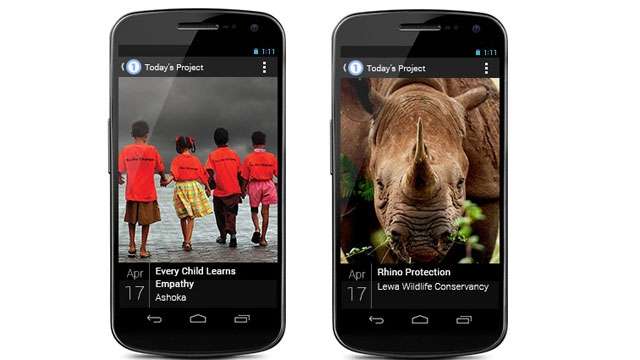
Being generous? There is an app for that! Google is testing its new app called One Today that “brings together people and nonprofits through the simple act of giving $1.” The app displays one good cause each day and urges you to make a simple donation of $1 towards it.

Built on the back of Google’s not-for-profit arm Google.org, One Today is an Android app that will get users to donate towards organisations and charities daily. The app is available for the US only currently and also has an invite-only status to it right now.

The best part about this app is the complete transparency it keeps about where your money is going. Google has listed a few examples on the One Today page. For example, with the “Every Child Learns Empathy” project, every $50 collected means one school will receive aid to be trained in empathy best practices. Every $2 donated will translate into an hour of security for a wild rhino. From helping poor farmers in Africa to helping nature and wildlife, One Today will display a new project everyday that needs funds.

Donate $1 a day to a cause of your choice

It’s a great crowdsourcing idea with a friends angle too. The app allows for you to set a cap in relation to how much money you will match if your friends donate to a particular project. You can then pay off your donation balance once your friends have used up the cap. Individually, you can only donate $1 per project per day. However, if you want to donate more, you can challenge your friends to match your donations, says the FAQs page of One Today.

Currently, the page for the project will only let you request for an invite. The app looks like its undergoing a controlled hush-hush test right now, but it could be possible that it is open to international audience as well. If you’re an organisation, you can already start to list yourself to be featured as the Project of the Day. The app is a great move on Google.org’s part and with its backing, One Today could turn into a revolutionary way of donating to charities.

Google.org was recently in the news for lending support to help victims of the Boston Marathon bombings reach their loved ones. The search giant activated its Person Finder app to help locate missing people.

The helpful tool was first activated during the Haiti earthquake in 2010.

When you logged into the page, you were shown two options. The first said “I’m looking for someone” and helped you find out if there was any information about a loved one you were searching for. If there was any positive information about the person you were searching for, a message that said “Status: Someone has received information that this person is alive" was shown on screen. You could then click to see where the information came from.

The second button read, “I have information about someone”. This tool was for people who have the whereabouts of people affected by the blast. Entering information using this button will helped people who’re searching for their loved ones co-ordinate information.

The app had managed to help locate thousands of people before it was deactivated a couple of days ago. Charities and not-for-profit organisations are in safe hands with One Today, it would seem.

Report by : Nishtha Kanal

Google Now Has $50 Billion in Cash for Acquisitions and Investments


Next time you wonder how Google can afford to buy dozens of startups every year, consider just how much money it has on hand.

The search giant's cash pile grew to just more than $50 billion in the March quarter, up from $48.1 billion at the end of 2012, the company revealed in its first quarter earnings report on Thursday. That's still less than half as much cash as Apple has, but it will likely serve as a powerful resource for Google to continue buying up technology and top talent from companies, as well as investing in so-called "moonshot" projects.

As Google's chairman Eric Schmidt pointed out during a Q&A session at AllThingsD's Dive Into Mobile conference earlier this week, he is not a fan of companies holding onto an excess amount of cash. "What I really think about tech companies and cash is that there is a point where you have enough cash that you need to either start investing that stuff or lowering your prices," he said. Simply letting the cash pile grow, he says, would be a "missed opportunity for investment."

Google has never been shy about using its money to invest in infrastructure and acquisitions. In 2011, the company spent $12.5 billion to acquire Motorola Mobility and its portfolio of patents. Earlier this year, Google's CFO suggested that the cash pile gives the company the "strategic ability to pounce" and, in the case of Motorola, "move on a dime" to make the acquisition.

While Google may have significantly less cash than Apple, its willingness to bet some of it on potentially risky companies and projects may be what sets it apart from Apple going forward. While Apple's stock price has collapsed below $400, Google's has climbed above $750 driven in part by the perception that it, unlike Apple, has more breakthrough products in the pipeline.

Even apart from the cash pile, Google's profits and revenue continue to grow as well. Google reported a profit of $11.58 per share in the first quarter on revenue of $13.97 billion, beating Wall Street's earnings estimates of $10.69, though falling short of revenue estimates of $14.04 billion.

The company still has some problems to fix in the short-term, most notably the decline in cost-per-clicks, which declined 4% in the first quarter from the year before, but the rate of decline has slowed, suggesting that it is stabilizing.

Report by : Seth Fiegerman

Google Glass runs on Android, CEO confirms


Google released specs of its glasses, Project Glass, earlier this week. While it included information like the camera resolution, storage and everything else, one key piece of information was missing - the operating system.

This mystery is now solved as Google CEO Larry Page mentioned in earnings call on Thursday that Google Glass indeed runs on Android. "[...] obviously Glass runs on Android, so it's been pretty transportable across devices, and I think that will continue."

This piece of news is expected to be welcomed by developers as it will make porting apps between Google Glass and Android-based smartphone apps easier.

When quizzed about the pricing of the Google Glass, Page did not give a definitive answer but mentioned that this thing would not come cheap. He mentioned, "We don't have any news to announce there [on price], but it was clearly - I'm not sure I'll call it a luxury price, but certainly a pretty high price." Page went on to justify the price, given the "experience" of the device.

"I think that what I'm, like doing with my Glass, I think - what do people do in Glass? I really - I find that photo taking and the video, phone calling, quick messaging, directions, all to be a pretty amazing experience and that's some of the core functionality we built into the device, we're excited to really get it out to some developers and have other people create some amazing experiences with it, which we haven't thought of yet. I guess that it's still early days. But I think it's very exciting."

Google had recently revealed the specifications of its Google Glass. The Internet-connected glasses will feature a 5-megapixel camera, which is capable of recording 720p videos. The search engine giant has not disclosed the exact specifications of the display inside Glass, but did mention that the resolution will be equivalent to that of a '25-inch high definition screen from eight feet away'. Google Glass will also feature a Bone Conduction Transducer for audio.

Glass will be compatible with any Bluetooth-capable phone, however, for using GPS and SMS it requires the MyGlass companion app which is only available for smartphones running Android 4.0.3 (Ice Cream Sandwich) or higher. As per Google, Glass will offer 16GB internal storage space out of which 12GB will be usable and will be synced with Google cloud storage.

The company doesn't specify the battery capacity but mentions that it will offer one full day of typical use, however, it also warns that some features, like Hangouts and video recording, are more battery intensive. Glass will include a Micro-USB cable and charger.

Report by : Surbhi Chawla

Google's 1Q shows more progress in mobile ads


Google's latest quarterly results provided further proof that the Internet search leader is figuring out how to make more money as Web surfers migrate from personal computers to mobile devices.

The first-quarter numbers released Thursday show that a recent decline in Google's average ad prices is easing. That's an indication that marketers are starting to pay more for the ads that Google distributes to smartphones and tablet computers. The company expects that trend to continue as it changes its pricing system and as mobile devices emerge as the most effective way to reach consumers.

In another encouraging sign, the Motorola cellphone business was less of a burden than it has been since Google bought it for $12.4 billion nearly a year ago.

Going the mobile way

Meanwhile, Google's core operations, such as Internet search, maps, video and email, remain reliable moneymakers.

Those factors, coupled with an unusually low tax rate, produced earnings that exceeded analyst estimates and pleased investors. Google's stock gained $11.09, or nearly 1.5 percent, to $777 in extended trading Thursday after the report came out.

As with most major technology companies, Google's future success is likely to hinge on its ability to adjust to an accelerating shift from computers controlled by keyboards and mice to mobile devices that respond to the touch of a finger and are usually within a person's reach.

Google has been among the companies leading the transition, thanks to the Android software that it has been giving away to device makers for the past five years. Android is now the leading mobile operating system. Most device makers using Android also prominently feature Google's services, giving the company more opportunities to sell ads.

Even so, the mobile upheaval has presented Google with challenges that have been worrying investors, despite the company's steadily rising earnings.

Mobile ads so far have fetched less money than those viewed on the larger screens of laptop and desktop computers. Google's average price, or the "cost per click" to advertisers, has fallen from the previous year in six consecutive quarters, including the first three months of the year.

Now, there are signs that marketers are starting to pay more for mobile ads. The first-quarter decrease in average ad prices was just 4 percent. By comparison, Google's average ad price fell by 6 percent during the final three months of last year and by 12 percent during last year's first quarter.

Google is a good way to monitor the health of digital commerce because it runs the Internet's largest advertising network and is now a major player in the mobile computing market. It's also one of the world's most powerful companies, so what happens to it can affect millions of people and businesses.

Google executives have insisted that advertisers eventually will pay more to sell things on mobile devices as people use more and more of them. To help speed the transition, Google is changing the way it sells ads to prod more marketers into buying spots on mobile devices at the same time they plan campaigns aimed at PCs. That switch is scheduled to take effect this summer.

"I have been very pleased with the rate of progress so far," CEO Larry Page said during a conference call with analysts. "In today's multiscreen world, the opportunities are endless."

Page have insisted that advertisers eventually will pay more to sell things on mobile devices as people use more and more of them. To help speed the transition, Google is changing the way it sells ads to prod more marketers into buying spots on mobile devices at the same time they plan campaigns aimed at PCs. Although that switch isn't to be completed until late June, about 1.5 million ad campaigns on Google already have changed over to the more mobile-friendly format, according to Nikesh Arora, the company's chief business officer.

Google Inc. earned $3.3 billion, or $9.94 per share, during the first three months of the year. That was a 16 percent increase from $2.9 billion, or $8.75 per share, in the same period last year.

If not for certain expenses, Google said it would have earned $11.58 per share. That figure exceeded the average earnings estimate of $10.65 per share among analysts surveyed by FactSet.

Google's tax rate in the quarter was just 8 percent compared with 18 percent at the same time last year. Chief Financial Officer Patrick Pichette said the reduction stemmed from research and development tax credits and a change in the mix of income from overseas, where Google typically pay or no tax.

Revenue climbed 31 percent to $14 billion, from $10.6 billion a year earlier.

After subtracting advertising commissions, Google's revenue totaled $11 billion - about $335 million below analyst estimates.

Google's stock increased $7.05, or nearly 1 percent, to $772.96 in extended trading after the numbers came out. Google has been growing at an impressive clip for a company of its size. Its ability to keep growing has given the company a market value of more than $250 billion, second only to Apple Inc. among technology companies.

Yet it faces competition with Facebook Inc. for ad dollars and attention. For a time, Facebook's popularity had people worried that it would eventually become a more important advertising vehicle than Google's search engine.

Google has countered that by establishing its own social network, Google Plus.

It also makes the most widely used smartphone operating system, Android. That gives the company channels for sending ads to mobile phone users, through built-in Google apps such as YouTube, maps and search. It is Facebook that has responded to Google's strengths in mobile advertising: Facebook took advantage of Android's openness and release a new app this month to make its social network front and center on phones.

Google dominates the mobile search market with 93 percent of U.S. mobile search advertising dollars, according to eMarketer. Facebook is at No. 2, ahead of online music service Pandora Inc. and Twitter. EMarketer expects U.S. mobile ad spending to grow 77 percent this year to $7.29 billion, from $4.11 billion last year.

Motorola Mobility's operating loss in the first quarter was $179 million, the smallest setback so far. Motorola Mobility has lost $1.25 billion since Google took control.

Google has been paring the losses by cutting jobs and shedding the part of Motorola Mobility that makes set-top boxes for cable television.

The company began laying off about 1,200 Motorola Mobility employees last month, adding to the 4,000 people that Google let go last year. Google also shed about 5,000 more workers Wednesday when it completed its $2.35 billion sale of the set-top business to Arris Group Inc. Google ended March with more than 38,700 workers in its core business and nearly 10,000 in the part of Motorola Mobility that it still owns.

Report by : Associated Press